
A High-Tech Glazing Lab, Used to Put the Hand Back In
Precision engineering, deployed to protect imperfection. Villeroy & Boch's glazing lab spent its effort making the human touch reproducible at factory scale.
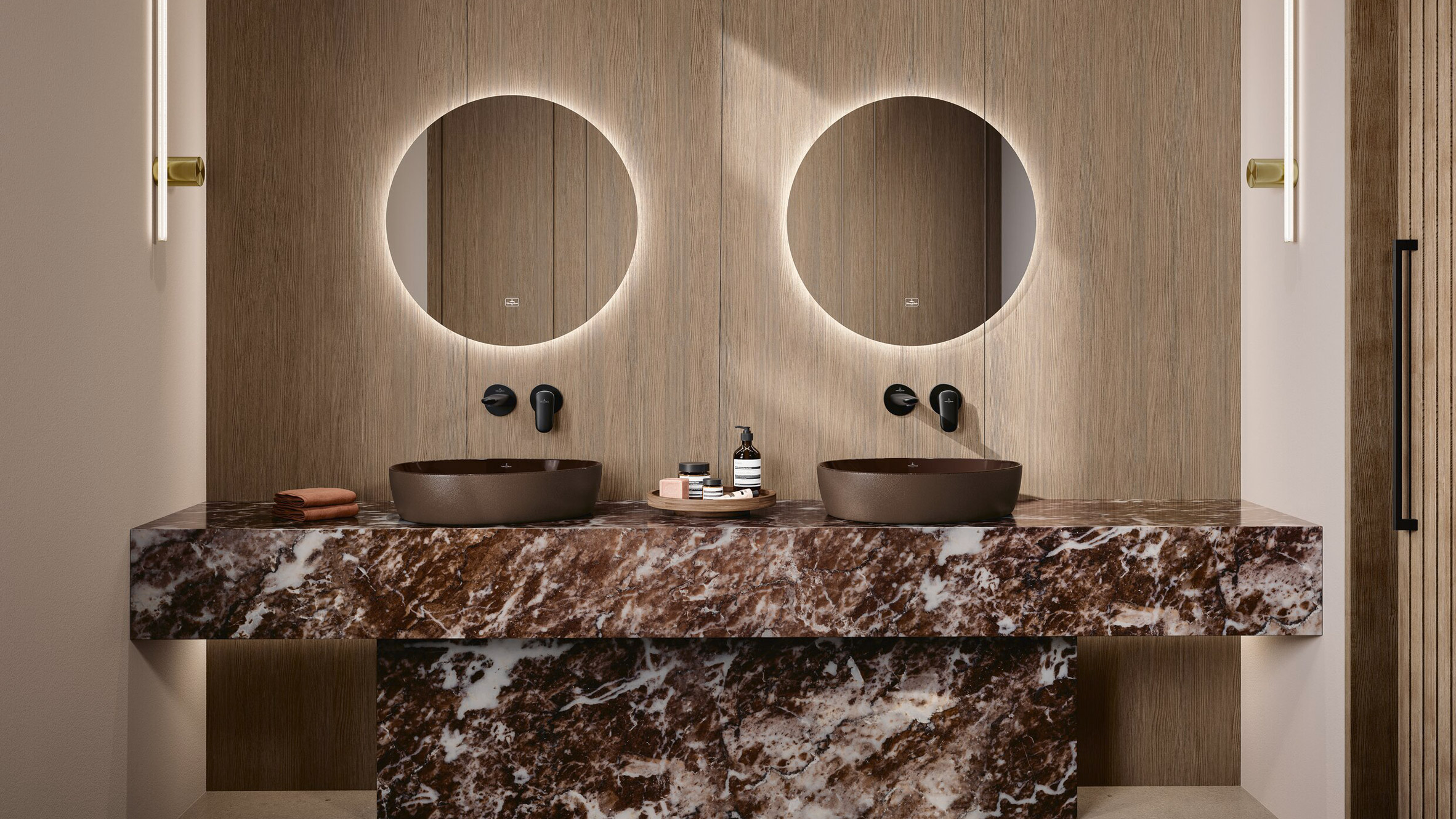
Cologne design studio KaschKasch and Villeroy & Boch have released Antao Earth, a series of hand-glazed, surface-mounted washbasins, covered this week on Dezeen Showroom. The basins take their asymmetric shape from a dewdrop and come in three colourways named like sediment: Sand, Terra, Smoke.
The interesting part is how the handmade surface gets made. Each basin is finished with what the brand calls an Artisan Glaze, applied by hand, but the glaze itself was developed at Villeroy & Boch's high-tech glazing lab in Mettlach, Germany. Co-founder Sebastian Schneider describes the problem plainly: "The physical complexity in the kiln is enormous. To extend such a structure to an entire basin in a controlled and reproducible manner calls for maximum precision." Read that twice. The precision engineering exists to protect the variation, the drips and thickness shifts that make each basin read as touched. And it has a sibling: earlier this year the same duo showed Antao 3D, a basin material printed layer by layer from 100 per cent internally recycled ceramic, its ribbed surface carrying the trace of its own formation.
Mass production spent a century deleting variation from ceramics; that was the whole point of the factory. Now one of the oldest ceramics companies in Europe is pointing its lab at putting the variation back, in a form it can warranty. Maybe this is what happens when "flawless" stops being the definition of premium. What if the next thing factories learn to reproduce reliably is the feeling that a person was there?