
You Can Draw How a Thing Moves. You Cannot Draw How It Feels to Watch.
A decade of working models, shown as the finished exhibition. Underneath it sits a claim worth borrowing: how an object moves is a personality trait, and somebody has to decide it.
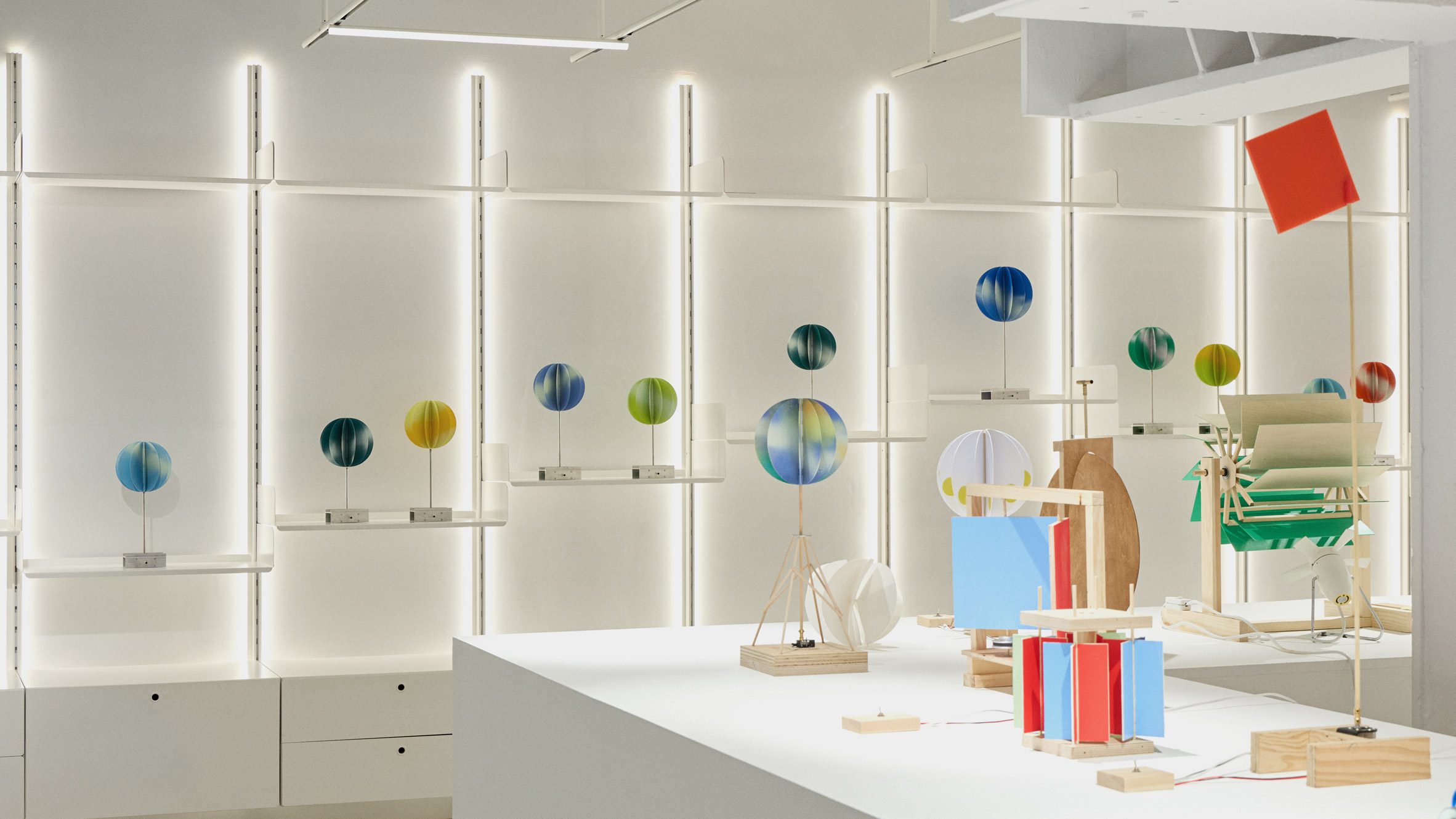
Isabel Gibson and Helen Chesner filled the basement gallery of The Conran Shop on Sloane Square with spinning orbs, flapping wings and wheeled devices. Dezeen toured the show with them today. Motion Sickness ran from 12 to 20 September as part of London Design Festival and marked ten years of their London studio, Isabel + Helen. Most of what sat on the tables were prototypes, built along the way to commissions for Hermès and Burberry and installations at the V&A and Coachella.
The objects are small, mechanical and legible. A toy train carries half a dozen eggs that wobble in time with one another as it rolls along the table. Fifteen paper spheres spin when you pull a string. The paintings behind them, each a colourful wheel of concentric circles, were made by a machine the pair built to spin a paintbrush, so the artwork and the mechanism that made it are a single decision. Small labels tell visitors to touch things. Gibson's account of how the studio works is that you can picture how something will move, and you can sketch it, but you have to get hands-on to see how it behaves in real life.
Chesner names the useful part directly. The way a thing moves changes how you see it, and the same object can read as joyful or as sinister depending on how it travels. That makes movement a channel for character, available to anything with a motor and a linkage, no screen and no face required. Most household electronics move in one register only, the smooth indifferent glide of an object with no opinion about what it is doing. What would a kettle or a blind or a desk lamp become if someone decided, at the prototype stage, how it should feel to watch it work?