
The Six-Year-Old Laptop That Boots Into Vim and Stays There
A six-year-old System76 Galago Pro with the desktop OS wiped, replaced by a black tty that boots straight into vim. Network-manager exists only so files can sync when there's signal. The rest of the time, the laptop just writes.
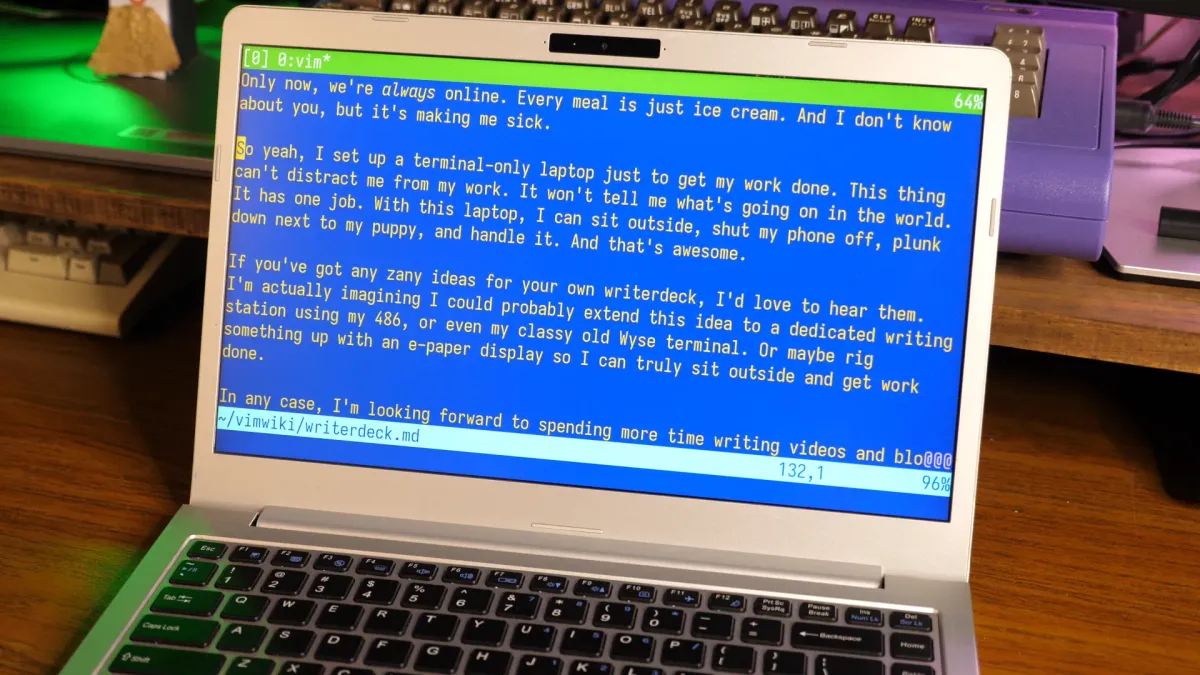
Veronica Castro-Walls, who writes at Veronica Explains, took a six-year-old System76 Galago Pro, wiped the desktop OS, and installed Debian Trixie in console-only mode. No browser, no window manager, no GUI at all. She published the build last week — by the time anyone read it, she'd already written the post about it, plus a video script, on the device itself.
The setup is software-subtraction taken to its logical end. The machine boots straight into a black tty. kmscon, pulled from Debian backports, scales the terminal with ctrl-plus like a browser. tmux sits at the top of the screen with a green status bar pinned to battery percentage and brightness keys. Neovim opens to vimwiki — a personal wiki — on autologin. Syncthing pushes the writing folder to her server when the laptop sees a network; the rest of the time it stays offline. Network-manager and nm-tui exist only because she wanted to sit outside with her dog and still back up files when she got home. The hardware did not change. The same Galago Pro, the same matte screen, the same keyboard. What changed was the answer to the question of what the object is for.
The most quotable line in her post is the closing one. "I want devices that do one thing really well, and that when I'm done with that one thing, I can put them away, and do something else." That sentence is the writerdeck movement in compressed form, but it also describes something larger. A generation looking at their existing hardware and asking what would happen if it remembered fewer things. Maybe this is what reuse looks like now. The same machine, with fewer ambitions. The object remembers less. The person remembers more.