
He Used to Sand the Dots Off. This Time He Left Them On.
Handmade paper stitched into lampshades, and steel beaten thin enough to pass for it. The marks left by the hammer used to get sanded away; this time they are the pattern.
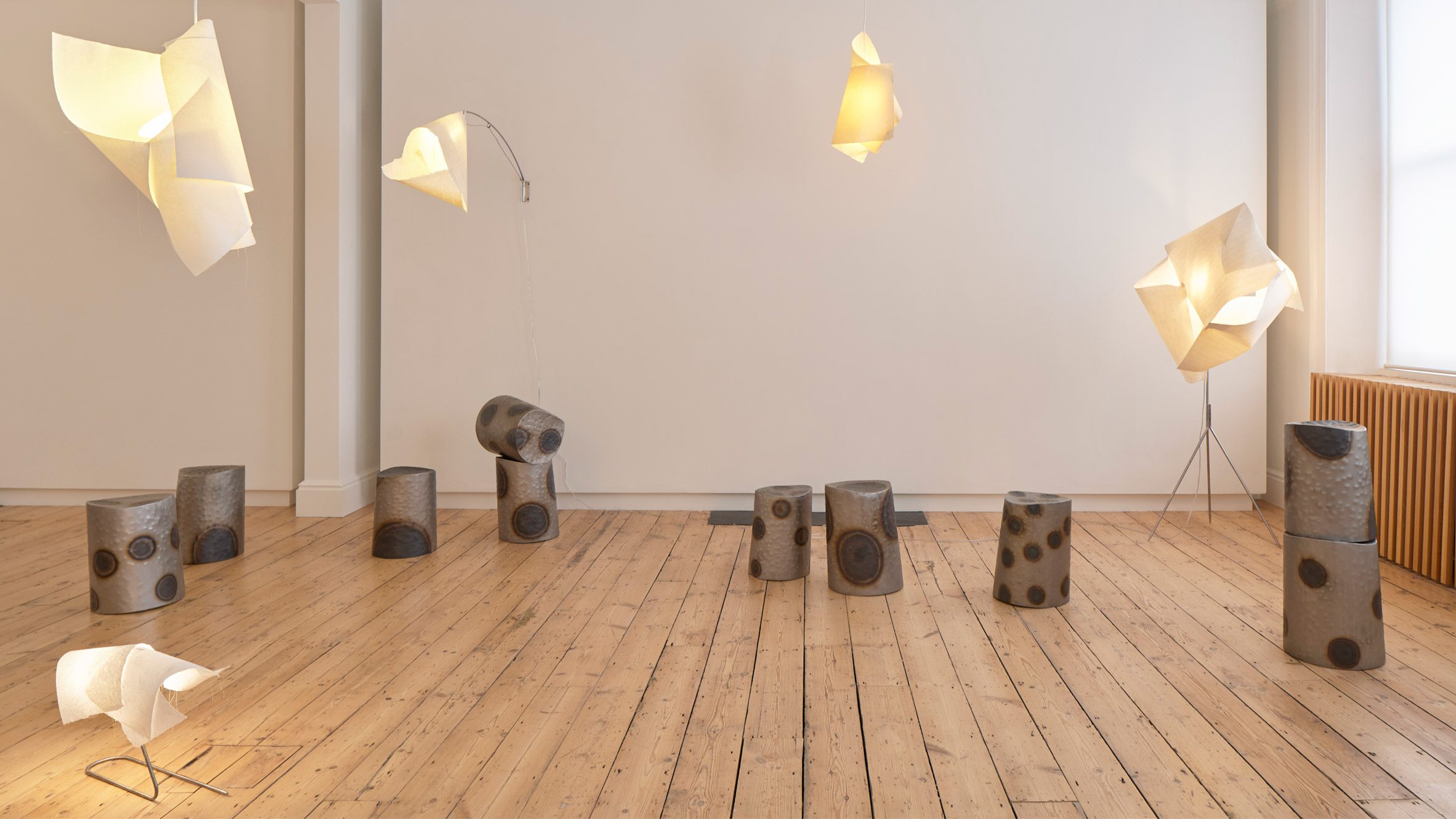
Jesse Butterfield showed two series of objects in the Brompton Design District during this year's London Design Festival, in an exhibition called A Veiled Boundary curated by Alex Tieghi-Walker. It ran from 12 to 20 September. Dezeen covered it this week: paper lamps stitched together by hand, and a set of steel stools hammered until they behave like the paper.
The lamps use handmade sheets from The Paper Foundation, a Lake District mill run by a sixth-generation papermaker, six or seven of them pulled out of the archive and chosen for how they drape and how they carry light. Slim stainless steel frames set each piece's form and purpose, pendant, wall, floor, table, and the paper is folded and draped and hand-stitched into shapes that hold no symmetry. The stools run the same idea backwards. Butterfield started from a paper model, scaled it up, then heated and hand-hammered sheet steel until it reached a thinness close to the paper it came from. Every stool comes off the same dimensions and no two of them match.
The dots on the steel are the part worth sitting with. Blackening is what happens when you heat metal and hit it, and Butterfield has sanded it off every time until now. Leaving it turns the record of the process into the pattern. The dots say the stool was made at all, by someone, on a particular day, and they say it permanently. What happens to an object's value when the evidence of the hand stops being the thing you polish away?