
The Victorian Weather Glass Doesn't Work. Two Hundred Years of People Have Kept One Anyway.
Camphor, saltpeter and sal ammoniac sealed in alcohol, growing crystals a Royal Navy admiral swore could read the coming storm. Science calls it a slow thermometer, and two centuries of windowsills have disagreed.
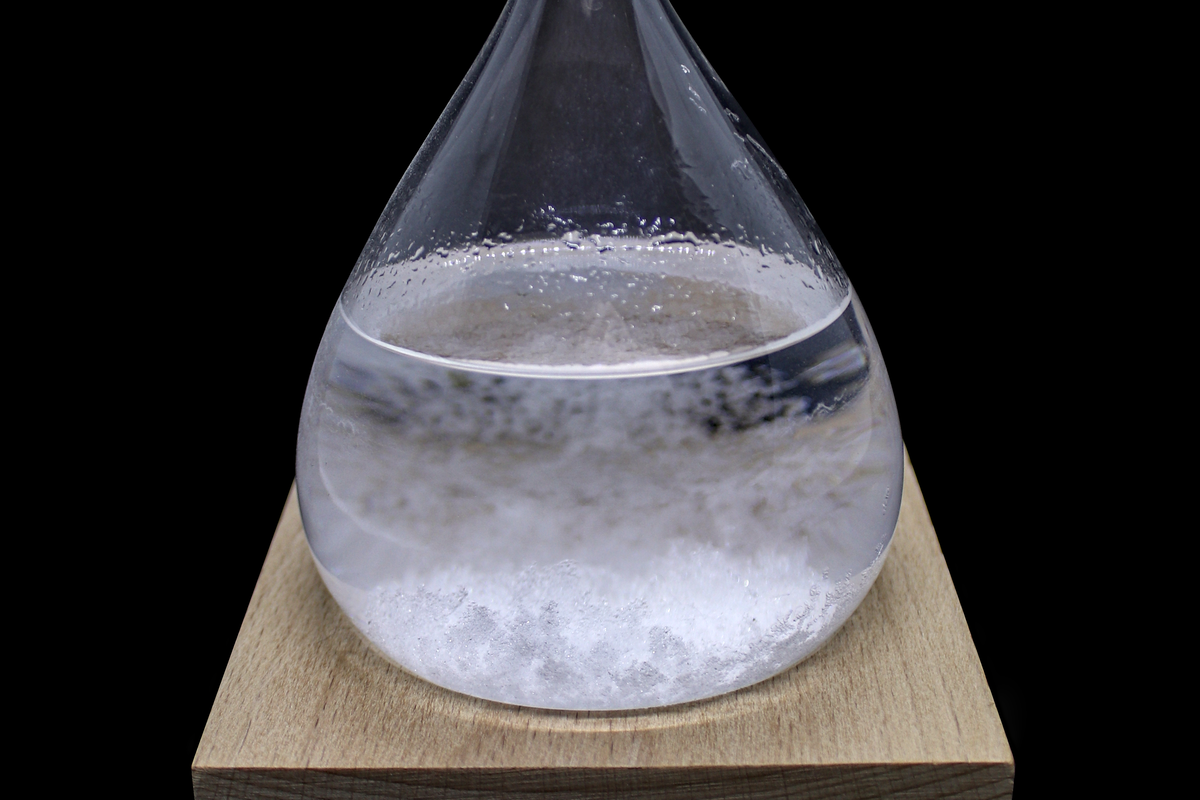
Hackaday ran a piece today on FitzRoy's storm glass, a sealed tube of alcohol, water, camphor, saltpeter and sal ammoniac that Victorian sailors kept aboard to read the coming weather. Vice Admiral Robert FitzRoy, the captain who carried Darwin on the Beagle, did not invent it, but he documented and promoted it heavily through the 1860s and issued it to British observation stations alongside real thermometers and barometers. It does not forecast weather. Charles Tomlinson said as much in the Philosophical Magazine in 1863, calling it little more than a crude thermometer, and a 2008 study reached the same conclusion.
The chemistry is the good part. Camphor dissolves readily in alcohol and poorly in water. Potassium nitrate and ammonium chloride lean the other way. The mixed solvent holds all three, but the camphor sits right at the edge of its solubility limit, so small shifts in temperature push it out of solution and pull it back in. The salts change the shape of what grows, which is why the tube fills with branching dendritic structures instead of plain sediment. Everything visible in the glass is a slow physical record of the last few days of temperature, rendered as feathers and needles.
One commenter on the piece noted you could write a phone app that draws the same crystals from an hourly temperature graph, then added that the glass jar looks cooler. That is the whole argument in two sentences. The data is the same either way. What changes is that nobody opens a temperature chart for pleasure, and people have kept these tubes on windowsills for two hundred years, watching a chemical process they were told does not work. What else are we currently reading off a screen that would be worth keeping in a jar?